Women's Bike Saddle Guide: Fit, Comfort and Less Pressure
A comfortable women's bike saddle does three things: it is wide enough to support your sit bones, its shape suits how upright or how far forward you sit, and it keeps pressure off the soft tissue at the front. Those three points matter more than a ‘women’s’ label. Many women ride happily on unisex saddles chosen by width and shape, and a saddle sold for women can still feel wrong if it does not match your posture. Here is how to choose, step by step, and how to set your new saddle up so it can do its job.
Why saddles often feel different for women
On average, women tend to have a wider pelvis and wider-set sit bones than men, and the pelvis often rotates further forward when leaning towards the handlebars. In practice that means two common complaints: a saddle that is too narrow, so you sit on its edges rather than on your sit bones, and pressure at the front, where soft tissue meets the nose of the saddle. Everyone is different, which is why measuring yourself and thinking about your riding position beats any generic rule.
Step 1: measure your sit bones
Your sit bones are the two bony points you feel when you sit on a hard bench. The saddle should support both of them.
- Put a piece of corrugated cardboard or a folded sheet of kitchen foil on a low, hard stool or step.
- Sit on it with your feet flat, then lift your knees slightly and lean forward a little, as you would on the bike.
- Stand up and look for the two deepest dents. Measure the distance between their centres in millimetres.
- Add a margin: a common rule of thumb is a couple of centimetres more for a sporty position, and more if you ride sitting upright, because your weight then rests further back on the widest part of the saddle.
Compare the result with the width listed for the saddle. If you are often between sizes on saddles too, our guide to choosing a wide bike seat explains when extra width helps and when it starts to rub.
Step 2: match the saddle to your riding position
| Your riding position | Where your weight goes | Saddle shape to look for | In our range |
|---|---|---|---|
| Upright: city bike, Dutch-style bike, e-bike | Mostly on the sit bones, little on the hands | Wide rear, generous padding, shorter nose | CycloSoft, MaxiComfort, UrbanSoft |
| Relaxed: hybrid, trekking, leisure rides | Sit bones and a little on the hands | Medium-wide, cushioned, ergonomic shape | SiliconRide, CycloSoft |
| Sporty: road or gravel bike, dropped bars | Further forward, more on the soft tissue | Narrower, firmer, central channel to relieve pressure | VeloxSeat, CycloSport |
The more you lean forward, the more the front of the saddle matters. A women's road bike saddle is usually narrower than a city saddle, but it should still support your sit bones and keep pressure off the centre.
Step 3: choose the right padding
Soft feels lovely in the shop and for the first few minutes. On longer rides, very soft padding can compress and push up into the area you are trying to protect. As a rough guide:
- Short, upright rides: plenty of cushioning is fine and often welcome.
- Rides of an hour or more: look for supportive padding placed under the sit bones rather than an even, squashy layer.
- Sporty riding: firmer padding, combined with padded cycling underwear, usually works better than a thick saddle.
Memory foam moulds to your shape and recovers between rides. Silicone feels softer and grippier. Both can be comfortable; your position and distance should decide.
Cut-outs and channels
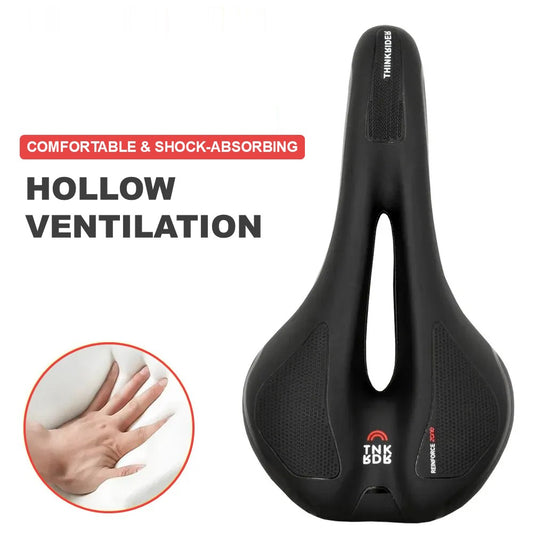
A cut-out or central channel removes material where soft tissue would otherwise press on the saddle. Many women riding in a forward position find it makes a noticeable difference. If front pressure is your main problem, check that the saddle you choose lists a central channel or cut-out, and look at how far forward you sit, since tilt and reach also change the pressure.
Our pick: for upright riding, commuting and e-bikes, the CycloSoft saddle (£44.95) has memory foam under the sit bones, a shock-absorbing structure and a non-slip surface. It measures 250 x 200 x 90 mm and fits seat posts with 7 mm rails. If you prefer a plusher feel, the SiliconRide (£49.95) uses a high-density silicone core with a non-slip top layer and fits all standard bike types.
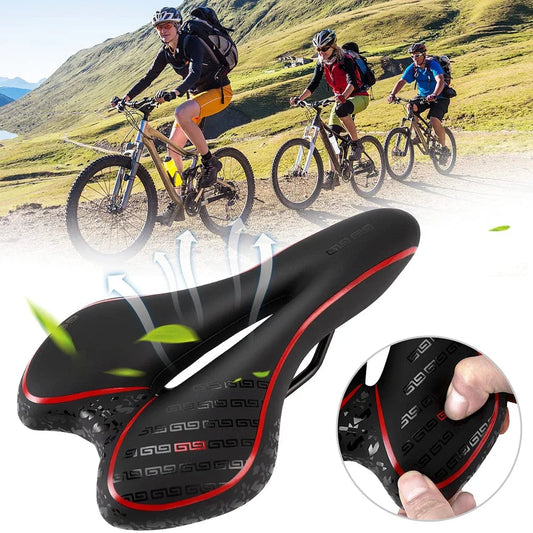
Our pick: for city riding in all weathers, the UrbanSoft saddle (£59.95) combines soft padding and a pressure-relieving shape with a water-repellent, grippy surface and integrated airflow channels that help with ventilation on warm days.
For sporty riders, the VeloxSeat (£49.95) has a central airflow channel and is designed to relieve pressure on sensitive areas. You can compare every model in our bike saddle collection.
Set it up properly
Even the right saddle can feel wrong if it is badly adjusted. Make one change at a time and give it a few rides.
- Level first. Start with the saddle flat. Some women find a very slight nose-down tilt eases front pressure; too much makes you slide forward and puts weight on your hands.
- Height. At the bottom of the pedal stroke your knee should still be slightly bent. Too high and you rock side to side, which causes rubbing.
- Fore and aft. Slide the saddle along its rails so you sit on the wide part, not perched on the nose.
- Handlebar reach. If you are stretched out, you rotate forward onto soft tissue. A shorter reach or higher bars can help as much as a new saddle.
Pair it with padded underwear
A saddle and a pad work together. Padded underwear adds cushioning, reduces friction and keeps you drier. Our guide to women's padded cycling underwear explains what to look for, and the GelCush (£39.95) is designed specifically for women, with a 5D gel pad and flat seams.
When to get advice
Numbness, swelling, tingling or soreness that lasts after a ride is a sign that something in your set-up needs to change. Our guide on numbness from a bike seat covers the usual causes. If symptoms persist or keep coming back, see your GP or a physiotherapist, who can rule out other causes and advise on position.
Saddles can be returned within 30 days if unused, with return postage paid by you, so measure your sit bones and read the dimensions before ordering. Delivery is free and tracked, and usually takes 7 to 10 business days after processing.
Frequently asked questions
Do women need a women-specific saddle?
Not necessarily. What matters is a width that supports your sit bones and a shape that suits your position. A women's saddle is a good starting point for many riders, but a unisex model chosen by width and shape can be just as comfortable.
Is a wider saddle always more comfortable?
No. A wide saddle suits upright riding, but on a sporty bike it can rub the inside of your thighs as you pedal. Choose the width that matches your sit bones plus a sensible margin for your posture.
Why does my saddle hurt at the front?
Usually because you are leaning forward onto soft tissue, the saddle nose is tilted up, or the saddle is too narrow to support your sit bones. A channel or cut-out, a level saddle and a shorter reach can all reduce front pressure.
How long does it take to get used to a new saddle?
Give it a few rides, starting with shorter ones. Some initial awareness is normal, but sharp pain or numbness is a sign the saddle or set-up is not right for you.
What is a good women's road bike saddle?
Look for a narrower, firmer saddle with a central channel or cut-out, wide enough at the back to support your sit bones. Pair it with well-fitting padded shorts or underwear for longer rides.