How to Fit a Bike Helmet: Size, Straps and Fit Checks
A bike helmet fits properly when it sits level on your head, about two finger-widths above your eyebrows, feels snug all the way round before you fasten the strap, and stays put when you shake your head. The side straps should meet in a V just below each ear, and the chin strap should be tight enough that only one or two fingers fit underneath. Start by measuring your head to get the right size, then work through the five adjustments below.
Step 1: measure your head
Helmet sizes are given as a range of head circumferences in centimetres, so a tape measure is all you need.
- Wrap a soft tape measure around the widest part of your head, roughly a finger-width above your eyebrows and ears, and around the back where your head is most rounded.
- Keep the tape level and snug, not tight. Measure twice and use the larger number.
- No soft tape? Use a piece of string, mark where it meets, then measure the string against a ruler.
Sizes vary from brand to brand, so always compare your measurement with the specific helmet's size chart rather than your old helmet's S, M or L. If your measurement falls inside a range, the adjustment dial at the back will take up the slack.
Step 2: position the helmet level
Put the helmet on without fastening anything. The front edge should sit low on your forehead, about two finger-widths above your eyebrows, and the helmet should be level from front to back. A common mistake is wearing it tipped back like a hat, which leaves the forehead exposed. When you look up, you should just be able to see the front rim of the helmet.
Step 3: tighten the retention system
Most helmets have a cradle at the back with a dial or slider. Turn it until the helmet feels snug and even all round, without pressure points. A good check: with the chin strap still undone, bend forward and gently shake your head. The helmet should stay in place. If it slides about, tighten the dial; if you cannot get it snug at the tightest setting, the helmet is too big.
Step 4: adjust the side straps
Each side strap divides into a front and rear section that meet at a buckle or slider. Move the sliders so the straps form a V that meets just below and slightly in front of each earlobe. The straps should lie flat against your face without twists and should not cover your ears. This step takes a few minutes the first time, but you rarely need to repeat it.
Step 5: fasten the chin strap
Buckle the chin strap and tighten it until you can fit no more than one or two fingers between the strap and your chin. Then open your mouth wide as if yawning: you should feel the helmet press down on the top of your head. If you do not, the strap is too loose. It should not be so tight that it is uncomfortable to swallow or talk.
Bike helmet fit checklist
Run through these checks every time you buy a new helmet or adjust your current one:
| Check | What a good fit looks like | If not, try this |
|---|---|---|
| Front position | Two finger-widths above your eyebrows, helmet level | Pull it forward; shorten the rear side straps if it keeps tipping back |
| Snugness | Even contact all round, stays on when you shake your head unbuckled | Tighten the rear dial; if already at its limit, choose a smaller size |
| Side straps | V shape just below each earlobe, lying flat | Move the sliders up or down; untwist the webbing |
| Chin strap | One or two fingers fit underneath; helmet pulls down when you yawn | Tighten or loosen at the buckle |
| Push test | Pushing the helmet up from the front or back barely moves it | Re-adjust the front or rear straps and the dial |
| Comfort | No pressure points or headache after a ride | Loosen the dial slightly; check the pads are seated properly |
Common fit problems and how to fix them
Glasses or sunglasses
Put your glasses on first, then the helmet. The arms should sit over or under the straps comfortably without the helmet pushing the frame down onto your nose. If they clash, adjust the retention cradle height if your helmet allows it.
Ponytails and long hair
A low ponytail can push the helmet forward. Wear it lower, below the cradle, or use a plait. Re-check the front position after changing your hairstyle.
Winter caps
A thin cycling cap or skull cap under your helmet is fine, but you will need to loosen the dial to fit it and tighten it again in spring. Avoid thick woolly hats, which stop the helmet sitting snugly.
Visors
A visor should shade your eyes without blocking your view of the road ahead when you are in your riding position. Our guide to choosing a bike helmet with a visor covers what to look for.
Safety markings and when to replace a helmet
Helmets are not compulsory for cyclists in the UK, but the Highway Code recommends wearing one. Bike helmets sold in the UK should carry the EN 1078 marking, so check the label inside and the product information before you buy any helmet. Replace your helmet after any crash or hard knock, even if you cannot see damage, because the impact-absorbing material may have compressed. Follow the manufacturer's advice on how long to keep it, and replace it sooner if the shell is cracked, the foam is dented or the straps are frayed.
For a wider look at choosing a helmet, read our guide to the best bike helmet in the UK.
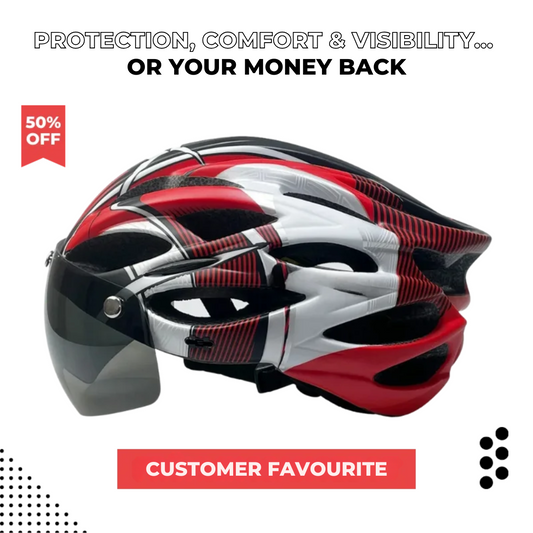
Our pick: the CycloGuard™ helmet in black (£74.95) comes in one size, M/L, for head circumferences of 54–62 cm, so measure first to check you are within that range. It has 24 air vents for airflow, a detachable visor that shields your eyes from wind, sun and rain, an impact-absorbing shell and a built-in LED at the back to help you be seen after dark. That rear LED adds visibility, but it does not replace the white front light and red rear light your bike must have when riding at night; our guide to a bike helmet with a light explains how to use both. As with any helmet, check the label and product information for the safety marking before you ride.
Browse all our helmets in the bike helmet collection. Delivery is free and tracked on every order. If the fit is not right, you can return the helmet unused within 30 days, with return postage paid by you, so try it on indoors with the tags still attached.
Frequently asked questions
How should a cycle helmet fit?
It should sit level, about two finger-widths above your eyebrows, feel snug all round, and not move when you shake your head. The side straps should form a V under each ear and the chin strap should allow one or two fingers underneath.
What size bike helmet do I need?
Measure around the widest part of your head, just above your eyebrows and ears, in centimetres. Then pick the helmet whose size range includes your measurement, using that brand's own chart.
How tight should a bike helmet chin strap be?
Tight enough that only one or two fingers fit between the strap and your chin, and the helmet pulls down when you open your mouth wide. It should never feel uncomfortable when you swallow.
Should a bike helmet cover your forehead?
Yes. The front rim should sit about two finger-widths above your eyebrows. A helmet pushed back on your head leaves your forehead unprotected.
Do you have to wear a helmet when cycling in the UK?
No, it is not a legal requirement for cyclists in the UK, but the Highway Code recommends wearing one that fits correctly and is securely fastened.