Bike Helmet with Light: LED Helmets for Night Visibility
A bike helmet with a light has an LED built into the shell, usually at the back, so drivers behind you can see you at head height as well as at wheel height. It is a genuinely useful extra for winter commutes and dusk rides, but it does not replace the white front light and red rear light your bike must have after dark. Choose the helmet first on fit, ventilation and safety marking, then look at the light. This guide explains what an LED helmet does well, what to check before you buy and how to stay visible at night.
What a helmet light does, and what it does not
A light on your helmet sits higher than the lights on your bike, often closer to a driver's eye line, and it moves with your head. When you look over your shoulder before turning, it turns with you. Many riders like that extra presence in traffic, particularly on dark country lanes and in busy town traffic.
What it does not do is make your bike road legal. In the UK, when you ride between sunset and sunrise your bike needs a white front light, a red rear light, a red rear reflector and amber pedal reflectors. A helmet light adds to that set-up; it is never a substitute for it.
Helmets in the UK: the basics
- Helmets are not compulsory for cyclists in the UK. The Highway Code recommends wearing one that fits properly and is securely fastened.
- Check the safety marking. Cycle helmets sold in the UK should carry the EN 1078 marking. Look for it on the label inside the helmet or in the product information before you buy any helmet, with or without a light.
- Fit comes first. A helmet only protects you properly when it sits level and snug. Our guide on how to fit a bike helmet takes you through it in a few minutes.
What to look for in an LED bike helmet
| Feature | Why it matters | What to check |
|---|---|---|
| Light position | A rear light is the most useful for traffic coming from behind | Whether the LED faces backwards and is not hidden by a ponytail or hood |
| Light modes | Steady and flashing modes suit different roads | Which modes are listed and how you switch them on with gloves |
| Power | A flat light is no light at all | How the light is powered and charged, according to the product information |
| Size range | The helmet must fit your head | Your head circumference against the stated size in cm |
| Ventilation | Commuting and climbing make you warm | Number and size of vents |
| Visor | Keeps low sun, wind and rain out of your eyes | Whether it is detachable and whether spares exist |
| Safety marking | Shows the helmet meets the standard for cycle helmets | EN 1078 on the label or in the product details |
Our LED helmet: CycloGuard
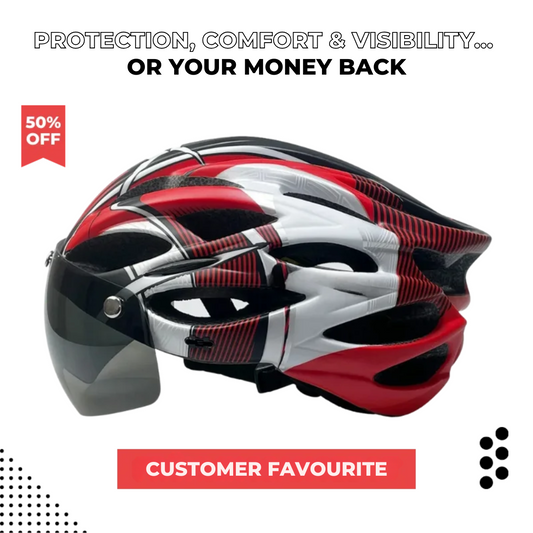
The CycloGuard is our helmet with a built-in light. It has an integrated LED at the back that increases your visibility after dark, a detachable visor that shields your eyes from wind, sun and rain, and 24 air vents to reduce heat build-up. The shell is impact-absorbing, and the helmet comes in one size, M/L, for head circumferences from 54 to 62 cm. It is designed for road cycling and mountain biking, and suits commuters who ride in all conditions.
Our pick: the CycloGuard helmet in black (£74.95) for riders who want a discreet look with a rear LED for winter evenings, or the CycloGuard in red (£74.95) if you want a brighter colour on top of the light. Measure your head first: it fits 54 to 62 cm. If you lose or scratch the visor, a replacement visor costs £7.95 and comes in Transparent Yellow, Transparent White or Iridium Gold.
Other colours and helmets are in our bike helmet collection. If the visor matters as much to you as the light, read our guide to choosing a bike helmet with a visor.
What does MIPS mean in helmets?
MIPS stands for Multi-directional Impact Protection System. It is a low-friction layer inside some helmets that lets the shell move slightly relative to your head in an angled impact, with the aim of reducing rotational forces. It is one of several rotational systems used by helmet makers. MIPS is not listed as a feature of the CycloGuard, so if a rotational system is a priority for you, check the product information of any helmet you consider. For a wider look at the market, see our guide to the best bike helmets in the UK.
Do you need the lightest helmet?
Weight is often the first thing people search for, but for most riders it matters less than you might think. A helmet that fits well, stays put and keeps you cool will feel comfortable on long rides even if it is not the lightest on the market, while a light helmet that rocks on your head will annoy you within minutes. Prioritise fit, retention system and ventilation, then compare weights between helmets that already tick those boxes.
Night riding checklist
A lit helmet works best as part of a full visibility set-up:
- White front light and red rear light on the bike, charged before you leave.
- Red rear reflector and amber pedal reflectors in place and clean.
- Your helmet LED switched on as an extra, higher point of light.
- Bright or reflective clothing, especially on legs and ankles, which move as you pedal.
- Reflective details on your bags. Our SaddleSwift saddle bag (£29.95) has reflective elements and a rear light attachment loop.
- A road position that keeps you clear of parked car doors and visible to drivers at junctions.
- Your phone tucked away. Plan your route before you set off and stop if you need to check it.
Looking after your helmet
Wipe the shell and visor with a damp cloth and mild soap, and let the pads dry naturally. Avoid solvents, which can damage the shell. Store the helmet away from strong heat, such as a car parcel shelf in summer. After any crash or a hard drop, replace the helmet even if you cannot see damage, because the impact-absorbing material may already have done its job.
Frequently asked questions
Is a helmet light enough to ride at night?
No. A helmet light is an extra. UK rules require a white front light, a red rear light and reflectors on the bike itself when you ride between sunset and sunrise.
Are LED bike helmets legal in the UK?
Yes. Extra lights on your helmet are fine, as long as your bike also carries the lights and reflectors it needs. A red light facing backwards is the usual choice on a helmet.
Do I have to wear a helmet when cycling in the UK?
No, helmets are not compulsory, but the Highway Code recommends wearing one that fits and is correctly fastened. If you do buy one, check for the EN 1078 marking.
What size is the CycloGuard helmet?
It comes in M/L, for head circumferences from 54 to 62 cm. Measure around your head just above the eyebrows and ears to check before ordering.
What are the best cycling helmets for visibility at night?
Look for a helmet with a rear LED, a bright or light colour and reflective details, and make sure it fits well. Combine it with proper bike lights and reflective clothing for the best overall visibility.